
Actually, I call it Slot Achievement Engine.
This might be left-field: it’s the way I think (I’ve disccovered). It’s actually thinking, predicated on a corporeal sensation, in three dimensions. I’m reminded of when Aldous Huxley first took LSD. He was disdappointed that he, uniquely, did not see wild surrealstic scenes with millions of colors. In The Doors of Perception, Aldous Huxley wrote about his mescaline experience in 1953, where he anticipated seeing “manycolored geometries, of animated architectures, rich with gems and fabulously lovely” but the experience focused on external reality. Well, that’s what it’s like being an “intellectual”. I’m not one. I DO see “manycolored geometries, of animated architectures”, but don’t need the LSD. In fact, it’s kind of a “disease” – chronic, I can’t get past it, or around it. Always with the geometries!
Quick plug: A fuller account of Huxley’s mescaline experience can be found on chiwijournal.substack.com.
So this thing gets built inside me, and is tangible. I can find it, and access it. And I get “signals” from it, when the “slots” get filled.
Here’s how I make each week:
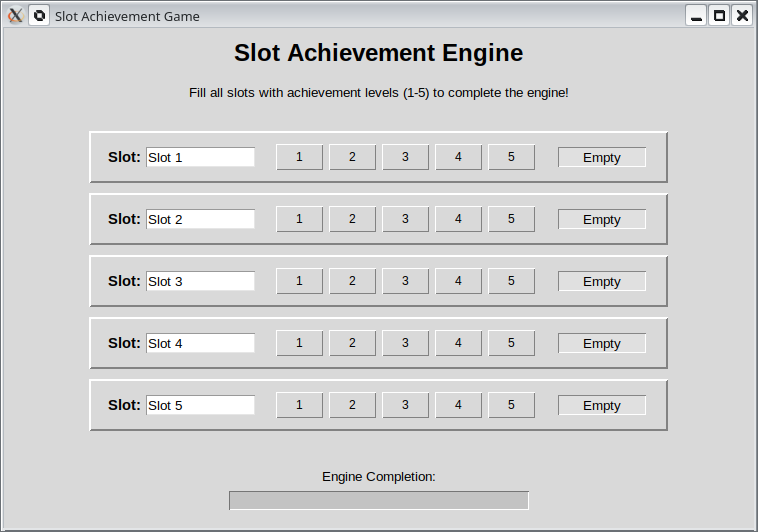
Slot Achievement Game – A mind-based achievement tracking system
This program implements a game with multiple fillable slots that track progress toward
completing an “engine”. Each slot can be customized with a unique name and assigned an
achievement level from 1 to 5.
Key Features:
- Multiple customizable slots (default: 5 slots)
- Each slot has an editable name field (format: “Slot:”)
- Achievement levels range from 1-5 for each slot
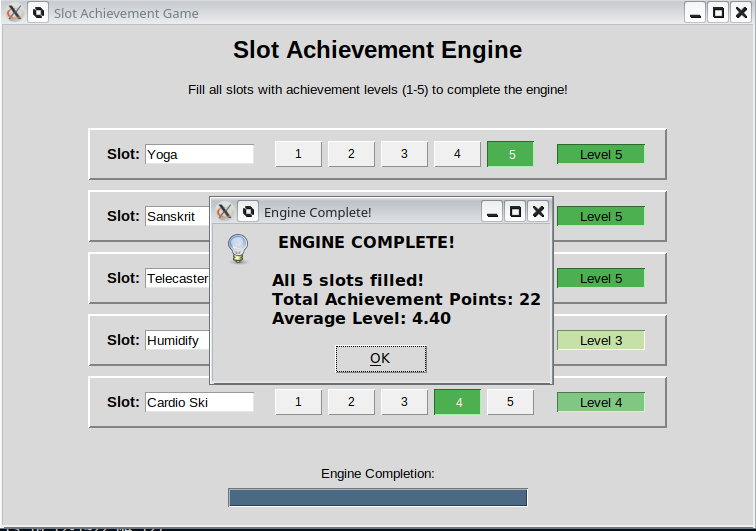
- Color-coded visual feedback:
- Real-time progress tracking with progress bar
- Completion notification when all slots are filled
- Reset functionality to clear all slots and names
The “engine” is considered complete when all slots have been filled with some achievement level:
What I am doing here is “mocking up” something that I have felt, lurking in my psyche, for quite some time, in order to share it with you. It’s not an “app”, in the digital world. For some people, there have always been “apps” – in the cerebral world – although I don’t use “cerebral” or “corporeal” in my own language. These kinds of concepts belong to a childish, “Western” conception of the human. I tend toward the Vedic teachings, which allow for such mechanisms to be a part of the human experience. In this case, I would term the realm for my inner coding “subtle body”, in contrast, or in harmony with, the physical body:
**Sukṣma-śarīra (सूक्ष्म‑शरीर)**
In the Vedic, Upaniṣadic and yogic traditions the “subtle body” is called **sukṣma‑śarīra**, literally
“*the fine or subtle body*.” It is distinct from:
| Aspect | Sanskrit term | Rough English equivalent |
|——–|—————|————————–|
| Gross physical body | **sthūla‑śarīra** (स्थूल‑शरीर) | “coarse/dense body” |
| Subtle body | **sukṣma‑śarīra** (सूक्ष्म‑शरीर) | “subtle, fine body” |
| Causal or causal‑karmic body | **karana‑śarīra** (कारण‑शरीर) / **para‑rūpa** (पर‑रूप) | “causal/seed
body” |
Terminology I use:
- engine: In computing, an “engine” refers to a core, specialized software component that provides specific functionality or “power” for a larger application, much like a car’s engine drives the vehicle but isn’t the whole car. It handles complex, repetitive tasks like processing data, rendering graphics, or running game logic, abstracting away low-level details and allowing developers to focus on the user experience, with examples including search engines, rendering engines, and database engines. Key Characteristics
- Core Functionality: It’s the central processing part, handling the “heavy lifting” of a program.
- Specialized: Engines are designed for specific tasks, like a physics engine for game simulations or a rendering engine for web browsers.
- Abstracted: It often works behind the scenes, providing an interface for other parts of the software without exposing complex internal workings to the user or other modules.
- Metaphorical: The term borrows from mechanical engines to signify a powerful, essential subsystem
- slot: A slot comprises the operation issue and data path machinery surrounding a set of one or more execution unit (also called a functional unit (FU)) which share these resources. A slot is a computer processor connection designed to make upgrading the processor easier, where the user would only have to slide a processor into a slot.
- game: In Wittgenstein’s theory, a “game” isn’t defined by a single set of essential properties but by a family resemblance: a network of overlapping similarities (rules, objectives, skills, fun) linking diverse activities like chess, cards, and ball games, showing no single common thread but rather a continuum of shared features, much like words in a “language-game” gain meaning through their use in specific contexts, not abstract definitions. To understand “game,” one learns its diverse uses and rules within a specific “language-game,” not by finding one universal essence
It’s easier for me to describe myself now, at age 63, partly because I have let my mind wander, and followed it closely. Now that I can “see” it, it doesn’t upset me so much.
 kronikoles